Pronouncing D-, T-
The letters D and T are represented by the International Phonetic Alphabet symbols /d/ and /t/.
You will hear the D (/d/) sound in words such as:
dollar /ˈdɑlər/
adore /əˈdɔr/
applaud /əˈplɔd/
You will hear the T (/t/) sound in words such as:
terror /ˈterər/
enter /ˈentər/
not /nɑt/
The D (/d/) and T (/t/) sounds are called alveolar sounds. Alveolar sounds are produced in the area of your mouth where your tongue meets 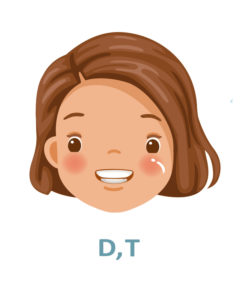 your gums (also known as the alveolar ridge). To produce the D (/d/) and T (/t/) sounds, the tip of your tongue will be a little tense as you touch the alveolar ridge and then release.
D (/d/) and T (/t/) sounds (much like B (/b/) and P (/p/) sounds) are consonant pairs. These two sounds are produced in the same area of your mouth with one sound being voiced (/d/) and the other sound is voiceless (/t/). So when you produce the /d/ sound, you will feel a vibration coming from your vocal cords while you won’t really feel that with /t/.
You will hear the D (/d/) sound in words such as:
adore /əˈdɔr/
applaud /əˈplɔd/
You will hear the T (/t/) sound in words such as:
enter /ˈentər/
not /nɑt/
your gums (also known as the alveolar ridge). To produce the D (/d/) and T (/t/) sounds, the tip of your tongue will be a little tense as you touch the alveolar ridge and then release.D (/d/) and T (/t/) sounds (much like B (/b/) and P (/p/) sounds) are consonant pairs. These two sounds are produced in the same area of your mouth with one sound being voiced (/d/) and the other sound is voiceless (/t/). So when you produce the /d/ sound, you will feel a vibration coming from your vocal cords while you won’t really feel that with /t/.