Pronouncing C-, K-, Q-, G-
In this section, we will be looking at the four letters: C-, K-, Q-, and G- together. All four of these letters have sounds that are produced in the same area of the mouth.
In the International Phonetic Alphabet, the letters C-, K- and Q- are all represented by the phonetic symbol /k/. The letter G- has a phonetic symbol of /g/. *The letters C- and G- can also have other phonetic symbols, but we’ll get to that a little later.
You will find the C-, K-, Q- (/k/) sound in words such as:
cant /kænt/
token /ˈtoʊkən/
equal /ˈikwəl/
You will find the G- (/g/) sound in words such as:
glass /ɡlæs/
agree /əˈɡri/
egg /eɡ/
These sounds are what we describe as velar sounds. Velar sounds are sounds that are produced on the back of the tongue. To produce both the C-, K-, Q- /k/ and G- /g/ sounds, 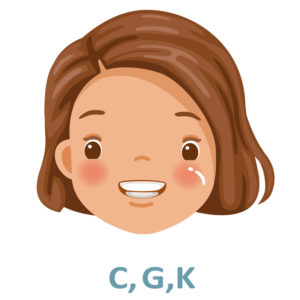 you will press the back of your tongue up against the back of your mouth (soft palate) and release.
The C-, K-, Q- /k/ sound is a voiceless consonant, so there is minimal vibration in your vocal cords when you produce the sound. Alternatively, G- (/g/) is a voiced consonant, which means that your vocal cords will vibrate when you produce the sound.
As I mentioned earlier, the letters C- and G- also have other phonetic symbols. C- and G-, when followed by the vowels e, i, (and the sometimes-vowel) y, take on the phonetic symbols of /s/ and /dʒ/ respectively. We call these sounds “Soft C” and “Soft G” sounds.
You will find the C- (/s/) sound in words such as:
cent /sent/
acid /ˈæsɪd/
convince /kənˈvɪns/
You will find the G- (/dʒ/) sound in words such as:
age /eɪdʒ/
change /tʃeɪndʒ/
gym /dʒɪm/
In the International Phonetic Alphabet, the letters C-, K- and Q- are all represented by the phonetic symbol /k/. The letter G- has a phonetic symbol of /g/. *The letters C- and G- can also have other phonetic symbols, but we’ll get to that a little later.
You will find the C-, K-, Q- (/k/) sound in words such as:
token /ˈtoʊkən/
equal /ˈikwəl/
You will find the G- (/g/) sound in words such as:
agree /əˈɡri/
egg /eɡ/
you will press the back of your tongue up against the back of your mouth (soft palate) and release.The C-, K-, Q- /k/ sound is a voiceless consonant, so there is minimal vibration in your vocal cords when you produce the sound. Alternatively, G- (/g/) is a voiced consonant, which means that your vocal cords will vibrate when you produce the sound.
As I mentioned earlier, the letters C- and G- also have other phonetic symbols. C- and G-, when followed by the vowels e, i, (and the sometimes-vowel) y, take on the phonetic symbols of /s/ and /dʒ/ respectively. We call these sounds “Soft C” and “Soft G” sounds.
You will find the C- (/s/) sound in words such as:
acid /ˈæsɪd/
convince /kənˈvɪns/
You will find the G- (/dʒ/) sound in words such as:
change /tʃeɪndʒ/
gym /dʒɪm/